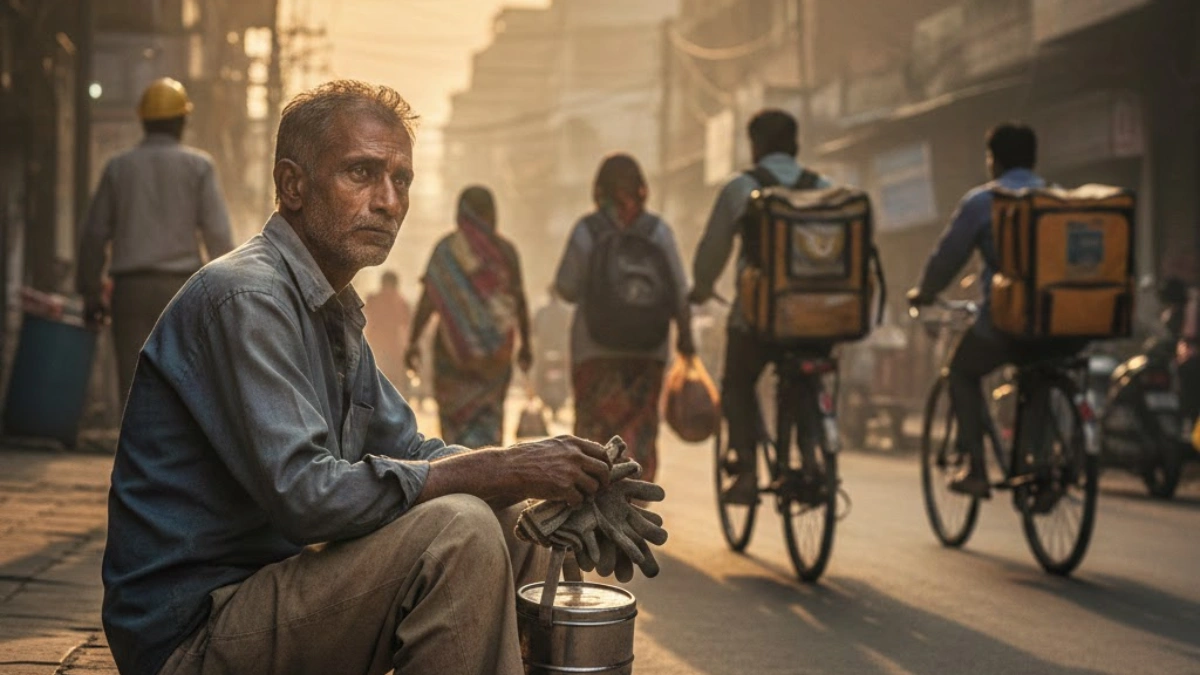
There are moments in every entrepreneur’s journey that quietly change everything. Not with noise or headlines—but with clarity. For me, that moment came on an ordinary afternoon while observing something that most of us see every day but rarely pause to understand: the reality of India’s informal workforce.
At first glance, the problem looked simple. Workers needed jobs. Employers needed reliable people. It seemed like a classic supply-and-demand gap waiting to be solved with technology. But the deeper I looked, the clearer it became—India’s workers didn’t just need more jobs. They needed dignity, trust, stability, and access to opportunity.
That realization reshaped how I understood the future of work in India.
The Illusion of “Employment Solved”

India is often described as a country full of opportunity. Walk through any busy market, residential colony, or construction site, and you will see thousands of people working hard every single day. On paper, many of them are “employed.”
But employment alone does not equal security.
I remember speaking with a skilled electrician who told me something that stayed with me:
“Kaam mil jata hai… par bharosa nahi milta.”
(Work is available… but trust is not.)
He wasn’t struggling to find occasional work. What he lacked was:
- Predictable income
- Verified identity in the market
- Fair pricing power
- Repeat customers
- Protection from payment delays
- Professional recognition
This is when the first crack appeared in the “jobs problem” narrative.
The Trust Deficit No One Talks About
India’s informal service economy runs heavily on word-of-mouth. A plumber is called because a neighbor recommended him. A carpenter gets work through a contractor’s contact list. A domestic helper is hired through a building guard.
While this system works at a small scale, it creates massive invisible barriers.
For workers:
- Hard to build reputation beyond local circles
- No formal proof of skills
- Constant price bargaining
- Limited growth path
- High income volatility
For customers:
- Uncertainty about reliability
- Safety concerns
- No standard pricing
- No accountability mechanism
- Difficulty finding urgent help
The more conversations I had, the clearer the pattern became: the real problem was not job availability—it was structured access to trusted work.
The Human Side of Informal Work
What struck me most was not the economics—but the psychology.
Many skilled workers carried quiet frustration. Not because they didn’t work hard, but because their effort rarely translated into upward mobility. A painter with ten years of experience was still negotiating daily wages. A technician with strong skills still depended on middlemen.
There was a visible gap between capability and recognition.
One worker told me:
“Sir, kaam toh main achha karta hoon, par log pehle doubt karte hain.”
(Sir, I do good work, but people doubt me first.)
That sentence captured the emotional weight of the informal economy. Before proving skill, workers first had to overcome suspicion.
This is where I realized—employment without trust keeps people stuck.
Why Technology Alone Isn’t Enough
In recent years, many platforms have attempted to “digitize jobs.” But simply listing workers online does not solve the deeper structural problems.
Because the real challenges include:
- Verification
- Standardization
- Quality assurance
- Customer confidence
- Worker protection
- Fair discovery
Without these layers, digital listings become just another crowded marketplace.
India’s workforce doesn’t just need visibility. It needs credibility infrastructure.
The Moment of Clarity
The turning point came during a simple observation. A household urgently needed a technician. The family spent hours calling contacts, asking neighbors, and scrolling through random listings.
Meanwhile, just a few streets away, skilled workers were sitting idle, waiting for calls.
Demand existed. Supply existed. Yet the connection was broken.
Not because of distance.
Not because of skill mismatch.
But because of trust friction.
That was the day the real problem became obvious:
India’s workers don’t just need jobs.
They need a system that makes them discoverable, trusted, and fairly valued.
What Workers Actually Need
Through repeated ground interactions, five core needs became clear.
1. Verified Identity
Workers want customers to trust them before the first visit. Verification is not just a safety feature—it is a confidence multiplier.
When a worker is verified:
- Customers book faster
- Price negotiations reduce
- Repeat business increases
- Professional image improves
Verification converts informal labor into credible service providers.
2. Consistent Demand Flow
Daily uncertainty is one of the biggest stress factors in the informal workforce.
Workers don’t just want more jobs—they want predictable work pipelines.
Consistency enables:
- Income planning
- Family stability
- Skill investment
- Reduced dependence on middlemen
3. Fair Price Discovery
In many informal markets, pricing is highly inconsistent. Workers often underquote out of fear of losing the job, while customers worry about being overcharged.
A structured platform can create:
- Transparent pricing bands
- Market-aligned rates
- Reduced bargaining friction
- Higher trust on both sides
4. Professional Recognition
One of the most underestimated needs is respect.
When workers are treated as professionals—not just “helpers”—their mindset shifts dramatically. They invest more in quality, punctuality, and customer experience.
Digital profiles, ratings, and repeat bookings help build this professional identity.
5. Growth Pathways
Most informal workers operate in survival mode. Few systems help them grow.
What they need:
- Skill upgrades
- Better-paying opportunities
- Customer feedback loops
- Reputation compounding
- Digital literacy support
Without growth pathways, the workforce remains trapped in low-margin cycles.
The Bigger Economic Picture
India’s informal workforce is massive. Millions of skilled individuals power homes, small businesses, and urban infrastructure daily. Yet much of this labor remains under-leveraged due to fragmentation.
If structured correctly, this sector can unlock:
- Higher productivity
- Better urban service reliability
- Increased household convenience
- Formal credit access for workers
- Stronger micro-entrepreneur ecosystems
In many ways, organizing informal labor is one of the biggest untapped efficiency opportunities in India’s service economy.
From Insight to Action
Once the problem became clear, the path forward also became clearer.
The goal was never just to create another job marketplace.
The real mission had to be:
- Build trust infrastructure
- Enable verified discovery
- Reduce friction for customers
- Increase dignity for workers
- Create repeatable income loops
Because when workers win, the entire service economy becomes more reliable.
The Road Ahead
India is at an inflection point. Urbanization is accelerating. Nuclear families are increasing. Time scarcity in households is rising. Demand for reliable on-demand services will only grow.
But the real transformation will not come from simply adding more workers to the market.
It will come from building systems that ensure:
- Trust
- Transparency
- Traceability
- Fair opportunity
- Professional dignity
The future of India’s workforce is not just about employment numbers. It is about quality of work access.
Final Reflection
That ordinary afternoon changed my perspective permanently.
What looked like a job shortage was actually a trust architecture gap.
What looked like underemployment was often under-recognition.
What looked like a supply problem was actually a credibility problem.
India’s workers have always been hardworking and skilled. What they have lacked is a structured ecosystem that consistently connects their capability with opportunity.
The day we stop seeing workers as just job seekers—and start seeing them as emerging micro-entrepreneurs—is the day India’s service economy will truly evolve.
And that realization continues to shape everything that comes next.